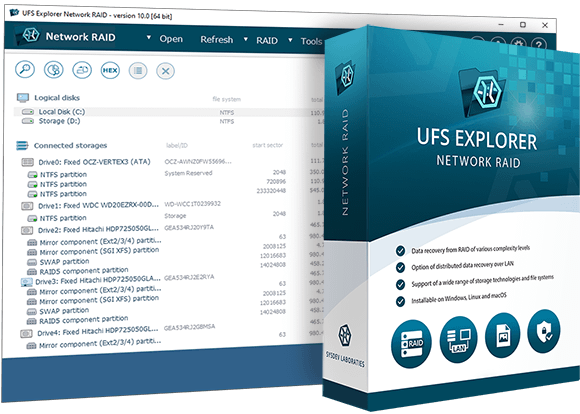
UFS Explorer Network RAID software interface
Available for: Windows macOS Linux

UFS Explorer Network RAID

Network-based RAID recovery across multiple computers
from $229.95

  • iSCSI client and server for accessing and sharing drives and assembled volumes over LAN
  • Native UDP protocol for low-latency data transfer between UFS Explorer instances
  • RAID assembly from member drives connected to different machines
  • Compatible with UFS Explorer Professional Recovery used as a network data source
  • Includes all RAID functionality: RAID Builder, NAS recognition, adaptive reconstruction
  • Available for Windows, macOS and Linux under a perpetual per-platform license
  • Free trial with 768 KB file-save limit; iSCSI server is limited to volumes of up to 2 TB

RAID recovery distributed over the network

RAID from drives on multiple machines
When not all RAID member drives can be attached to a single workstation, UFS Explorer Network RAID assembles the array across multiple computers on the local network, with each machine contributing its connected drives.
Built-in iSCSI target and initiator
The software connects to remote drives and SAN servers as an iSCSI client. At the same time, it can present assembled volumes as an iSCSI target, making them available as local virtual disks in Windows, macOS or Linux.
Native UDP protocol for lower latency
Alongside iSCSI, the software uses its own UDP-based protocol for peer-to-peer communication between UFS Explorer instances, delivering lower overhead on high-speed LANs, such as 10 Gbit networks.
Supports the Professional edition as a source
UFS Explorer Professional Recovery can be used as a network data source. Its fully functional free trial can serve as a remote imaging agent when paired with a licensed UFS Explorer Network RAID installation.
Full capabilities of UFS Explorer RAID Recovery
All RAID-related features, including automatic RAID detection, NAS vendor recognition, manual RAID Builder and adaptive RAID reconstruction, along with DeepSpar DDI support, are fully available in this edition.
Overview

About the software

UFS Explorer Network RAID is the most advanced edition in the Сlassic product family. It includes all features of UFS Explorer RAID Recovery and adds one key capability: it can access drives connected to other computers on the local network as if they were local. This is especially useful when a RAID array contains more member drives than a single workstation can physically host, when specialized hardware has a limited number of ports, or when a remote machine offers a more suitable operating system or performance environment for a specific task.

At 10 Gbit LAN speeds, the practical difference between a local SAS connection and a network connection is minimal. Even on 1 Gbit networks, the workflow remains efficient for most recovery operations. The software communicates with other UFS Explorer instances using either standard iSCSI or its own UDP-based protocol with lower overhead. Both are available at the same time.

The iSCSI target capability, in addition to the iSCSI initiator, allows assembled volumes to be shared with any iSCSI-capable client, including Windows iSCSI Initiator, other UFS Explorer editions or compatible third-party tools. A common workflow is to expose a reconstructed NAS volume as a local virtual disk on the recovery workstation, then access it using standard OS tools alongside UFS Explorer.

When the software is licensed, only the instance used to save recovered files requires a license. Instances running on remote machines and used solely for sharing drives over the network do not need to be licensed.

Typical network recovery workflow
A
Recovery workstation (licensed)
Runs UFS Explorer Network RAID, assembles RAID, performs scanning, saves recovered data
B
Remote machine 1 (unlicensed)
Shares locally connected drives over UDP or iSCSI
C
Remote machine 2 (unlicensed)
Runs UFS Explorer Professional Recovery in free trial mode, acting as a network data source
D
Windows host (iSCSI Initiator)
Mounts the assembled volume from UFS Explorer Network RAID as a local SCSI disk
Supported scenarios

What can UFS Explorer Network RAID handle?

UFS Explorer Network RAID is designed for data recovery workflows that span more than one physical machine. The scenarios below describe cases that require functionality beyond UFS Explorer RAID Recovery.

More drives than available ports

Large RAID arrays of 12, 16, 24 drives or more often exceed the port capacity of a single workstation's HBA cards. In such cases, drives can be distributed across two or three machines on the same LAN, with each machine sharing its drives to the UFS Explorer Network RAID instance performing the assembly.

Mounting the assembled volume as a local disk

After assembling a NAS or RAID volume, the iSCSI target can present it as a standard SCSI disk to iSCSI clients. Windows iSCSI Initiator can mount it as a local drive letter, making the recovered data directly accessible in File Explorer or other applications without prior copying.

Professional Recovery as a remote data source

Access UFS Explorer Professional Recovery’s hardware-level capabilities, including DeepSpar DDI and specialist HBA support, without applying a Professional Recovery license for data saving. The software provides a fully functional free trial, allowing it to run on a remote machine and expose the connected drives and storage to UFS Explorer Network RAID over the local network.

Remote machine with a different OS

When drives from a Linux-based NAS need to be connected to a Linux system for correct low-level handling, but the recovery workstation runs Windows, UFS Explorer Network RAID bridges the two environments. The Linux machine shares the drives, while the Windows workstation performs the RAID assembly and recovery.

If all RAID member drives can be connected to a single workstation, UFS Explorer RAID Recovery provides the same RAID engine at a lower cost. UFS Explorer Network RAID is a more advanced alternative for workflows that require LAN connectivity.
What sets it apart

Network functionality in detail

iSCSI initiator and target

As an iSCSI initiator, the software connects to standard iSCSI targets on the network, including SAN servers, NAS devices running in iSCSI mode, DeepSpar DDI hardware or other UFS Explorer instances. This allows the program to treat a drive connected to a remote machine as if it were locally attached.

As an iSCSI target, the software exposes assembled volumes, including reconstructed RAID arrays, to the network. Any iSCSI-capable client can connect, such as Windows iSCSI Initiator, Linux iscsiadm or another instance of UFS Explorer in a multi-stage workflow.

Network protocol support
iSCSI clientConnects to SAN, NAS, DDI hardware, UFS Explorer agents
iSCSI serverPresents assembled volumes to Windows, Linux and other clients
Native UDPPeer-to-peer communication with other UFS Explorer instances; lower overhead
DeepSpar DDIDirect DDI protocol support for remote imaging control
License scopeOnly the instance used for saving requires a license; remote agents do not

Using UFS Explorer Professional Recovery as a data source

UFS Explorer Professional Recovery, the flagship product in the Professional family, runs a network agent that exposes its connected storage to other UFS Explorer applications. Because UFS Explorer Professional Recovery has a fully functional free trial, it can be installed and used on a remote machine purely as a data-sharing agent without any licensing cost required for that machine.

The recovery workstation, running licensed UFS Explorer Network RAID, connects to the Professional Recovery agent, accesses the drives it provides, assembles the RAID and performs the recovery. This combination makes the full hardware-level capabilities of UFS Explorer Professional Recovery available, including its extended HBA support and forensic tools, while the actual data saving is performed on the UFS Explorer Network RAID side.

Professional Recovery + Network RAID workflow
1
Install the Professional edition on the machine hosting drives
No license required; the trial acts as a network agent that exposes drives over the network.
2
Connect UFS Explorer Network RAID to the Professional Recovery agent
Native UDP protocol or iSCSI can be used; the drives appear as network storage.
3
Assemble RAID and recover data on the Network RAID workstation
Use the full RAID engine on the Network RAID side; saving recovered data requires a license.
Technical specifications

Technical specifications

UFS Explorer Network RAID inherits all specifications of UFS Explorer RAID Recovery. The items below describe only the additional capabilities introduced in this edition. For details on RAID levels, NAS vendor support, file system coverage, disk image formats and system requirements, see the UFS Explorer RAID Recovery specifications page.

Network protocols and connectivity

iSCSI Initiator
Connects to remote iSCSI targets (SAN servers, NAS, DDI hardware, other UFS Explorer instances)
iSCSI Target
Makes assembled RAID volumes and individual drives available to any iSCSI client; limited to volumes up to 2 TB in the trial version
UDP protocol
A peer-to-peer protocol used for communication between UFS Explorer Network RAID instances; offers lower latency than iSCSI
DeepSpar DDI
Enables remote imaging task management, terminal access and performance monitoring via the DDI protocol
Professional edition
Compatible with UFS Explorer Professional Recovery used as a network data agent

Trial version limitations

  • File saving: up to 768 KB per file
  • Embedded iSCSI server: limited to volumes up to 2 TB
  • RAID assembly, network connectivity and data preview: fully unrestricted
  • Disk imager: no file-size limitation

Licensing model

Only the instance used to save recovered files requires a license. Remote machines running UFS Explorer Network RAID or UFS Explorer Professional Recovery solely to share drives over the network do not need to be licensed.

Starting prices
Personal: $229.95
Commercial: $484.95
Corporate: $839.95
Frequently asked questions

Frequently asked questions

What is the difference between UFS Explorer Network RAID and the RAID edition?
UFS Explorer Network RAID includes everything UFS Explorer RAID Recovery has to offer: the same RAID engine, NAS metadata recognition, RAID Builder, adaptive reconstruction and all disk imaging tools. Beyond that, it provides LAN-based connectivity through an iSCSI initiator, an iSCSI target (server) and a native UDP protocol for lower-latency communication between UFS Explorer instances. This enables RAID assembly from drives on multiple networked machines and allows you to share assembled volumes with other systems. In the trial version, the iSCSI server is limited to volumes up to 2 TB.
How does the iSCSI integration work?
UFS Explorer Network RAID works both as an iSCSI initiator and as an iSCSI target. As an initiator, it connects to remote iSCSI targets such as SAN servers, NAS systems in iSCSI mode, DeepSpar DDI hardware or other UFS Explorer instances. As a target, it can share assembled volumes or individual drives with iSCSI clients. For example, after assembling a NAS volume from drives on a remote machine, you can expose it as a virtual SCSI disk to Windows iSCSI Initiator on the recovery workstation and then access the recovered data directly through Windows Explorer.
Can UFS Explorer Network RAID work with UFS Explorer Professional Recovery?
Yes. UFS Explorer Professional Recovery can act as a network data source for UFS Explorer Network RAID. Install the Professional edition on the machine hosting the drives; its free trial version is fully functional, so no license is needed on that machine for this role. UFS Explorer Network RAID on the recovery workstation connects to the Professional Recovery instance, accesses the shared drives, assembles the RAID and performs recovery. Only the UFS Explorer Network RAID instance used to save recovered files requires a purchased license.
When is UFS Explorer Network RAID preferred over RAID Recovery?
UFS Explorer Network RAID is required when the recovery workflow spans multiple physical machines. This includes situations when the number of RAID member drives exceeds the number of free HBA ports on a single workstation, when drives are distributed across different systems on the same LAN, when a more powerful or better-configured remote machine is available to host the drives, or when the iSCSI target functionality is needed to mount assembled volumes on another system. If all drives can be connected locally, UFS Explorer RAID Recovery is sufficient and more cost-effective.
What are the trial limitations?
The trial version is fully functional for network connectivity, RAID assembly, scanning and previewing data, with no time limit. Disk imaging is also unlimited in the trial version. However, two limitations still apply: individual files can only be saved if they are up to 768 KB in size, and the embedded iSCSI target server is limited to exposing volumes up to 2 TB. A purchased license removes both restrictions.

Software releases

The current version of the product is available on the download page.

We appreciate your interest in UFS Explorer. Follow us on social media for regular updates on the software.